School teacher training programs

School Teacher Training Programs: The Mistakes Indian K-12 Schools Keep Making in 2026

A 2025 meta-analysis of 128 high-quality studies on teacher professional development found something that should unsettle any trustee currently budgeting purely for compliance. The number of training hours barely predicted whether anything changed in the classroom. What mattered was coaching, follow-through, and how closely the content matched what a teacher actually taught the following Monday.

NatureNurture works with school leaders across CBSE, ICSE, IB, and Cambridge affiliated schools in India on exactly this shift, from hours logged to practice changed, because most schools are still buying School Teacher Training programs the way they buy stationery, in bulk, once a year, against a hard number.

School teacher training programs work only when hours are paired with coaching, curriculum alignment, and measurable classroom application, not when they exist to satisfy the CBSE fifty-hour requirement on paper.

Compliance is not impact

Why Fifty Hours a Year Does Not Guarantee a Better Classroom

The CBSE mandate is specific. Every affiliated teacher completes fifty hours of continuous professional development each academic year, split into twenty five hours from external, CBSE recognised sources such as its Centres of Excellence or the DIKSHA and SWAYAM platforms, and twenty five hours of internal, school based activity. Since the guidelines were updated in April 2025, those hours sit inside three domains aligned to the draft National Professional Standards for Teachers, namely Core Values and Ethics, Knowledge and Practice, and Professional Growth and Development, with a national theme set each year (2025 was STEM education).

This is a genuinely useful structure on paper. The trouble is what schools do with it. Older UDISE+ figures found fewer than a quarter of all teachers received any on the job training in a single year, and while more recent figures show the overwhelming majority of teachers are formally trained, that measures basic qualification, not whether a teacher sat through anything useful last term. A CBSE affiliated school in western India learned this the hard way. It had logged its full fifty-hour requirement for two years running through unrelated online modules, only to find at its next quality review that training compliance and observed classroom practice barely correlated. The hours existed. The change did not.

Common failure points

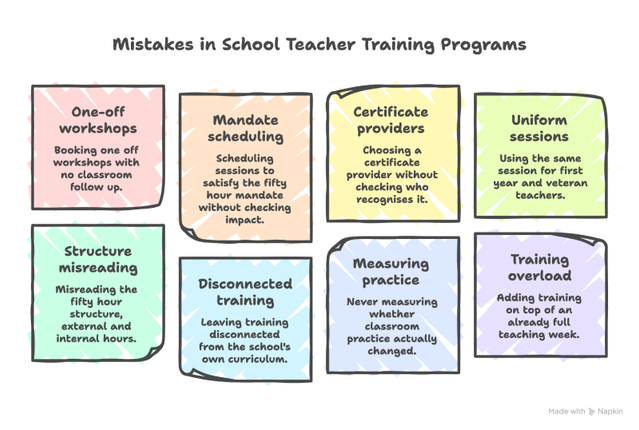
Eight Mistakes School Leaders Make with Teacher Training Programs

Most school teacher training programs fail for reasons that repeat across schools, not for reasons unique to any one of them.

choo
Booking one off workshops with no classroom follow up.

Research across sectors puts the share of training never applied on the job as high as sixty to ninety per cent within ninety days, and fewer than fifteen per cent of organisations even measure whether it stuck.

A session gets scheduled to satisfy the fifty-hour mandate, and nobody checks afterwards whether it changed anything.

The strongest available meta-analysis on the subject found that training hours and trainer type were not statistically significant predictors of classroom impact. Coaching and structured application predicted impact. Attendance did not.

Choosing a certificate provider without asking who actually recognises it.

A certificate with no link to NCTE, a board, a university, or an SCERT carries little more weight than the paper it is printed on.

The same session gets used for a first year teacher and a fifteen year veteran, because career stage was never part of the plan.

Most programmes are still designed as one size fits all, despite a beginner and an expert teacher needing entirely different input.

Misreading the fifty-hour structure itself.

Some schools count only the external twenty five hours and neglect the internal twenty five, or never map either half against the three CPD domains, which quietly puts the school out of step with its own compliance record.

Training content has nothing to do with the curriculum a teacher actually delivers, or the school's own Holistic Progress Card reporting.

Generic pedagogy input that never touches a school's competency framework rarely survives contact with a real lesson plan.

Nobody measures whether practice changed once the certificate is issued.

Attendance accumulates while lesson observation data, student outcomes, and School Quality Assessment and Assurance Framework evidence go unchecked.

Adding training on top of an already full week.

A teacher already stretched thin absorbs almost nothing from an evening session bolted onto a normal working day, whatever the certificate at the end says.

Certificate value

What Actually Makes a School Teacher Training Certificate Worth Something

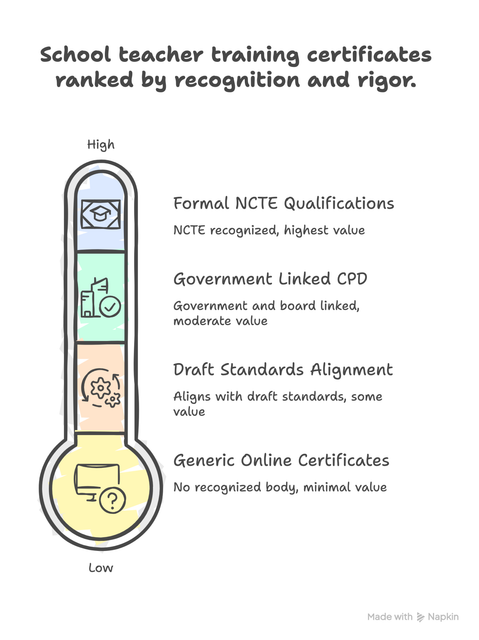
Certificate is doing a lot of work in this keyword cluster, and for good reason. A search for a School Teacher Training Certificate is often where this confusion starts. Trustees are being sold certificates constantly, and not all of them mean anything. A useful way to think about it is as a hierarchy, from most to least defensible.

At the top sit formal qualifications from institutions recognised by the National Council for Teacher Education, the statutory body that governs teacher education in India, covering routes such as the B.Ed., the D.El.Ed., and the newer four year Integrated Teacher Education Programme, which NEP 2020 intends to become the minimum degree qualification for school teachers by 2030. Below that sit government and board linked CPD routes, NISHTHA delivered through DIKSHA, CBSE Centres of Excellence, SCERT programmes, and university affiliated courses, all of which count cleanly toward the fifty-hour requirement and carry institutional weight behind them. Further down sit certificates aligned to the draft National Professional Standards for Teachers and to NCF-SE 2023 competencies, which are not yet a legal requirement but are becoming the benchmark serious schools ask about. At the bottom sit generic online courses with no recognised body behind them at all, which a busy academic head can mistake for real professional development simply because a certificate arrives at the end.

NatureNurture does not issue certificates or act as an accrediting body. Its role is narrower and, for most schools, more useful, connecting a school's training plan to routes that already carry recognition, and making sure whatever a teacher completes actually maps to the fifty-hour structure and the standards a school will eventually be judged against.

NCTE recognised

B.Ed., D.El.Ed., and Integrated Teacher Education Programme routes.

Board linked CPD

NISHTHA, DIKSHA, CBSE Centres of Excellence, SCERT, and university linked courses.

NPST aligned

Mapped to draft National Professional Standards for Teachers and NCF-SE 2023 competencies.

Generic online

No recognised body behind the certificate at all.

goverment
Board comparison

How CBSE, ICSE, IB, and Cambridge Compare on Teacher Training Requirements

Of the four boards most Indian K-12 schools work with, only one sets a fixed annual number.

Swipe sideways to view the full table.

BoardTraining requirementHow it is measured
CBSEFifty hours per teacher per yearTwenty five external, twenty five internal, logged against three NPST aligned domains
ICSE / CISCETraining required, no published fixed annual hour figureDelivered through its own Research Development and Consultancy Division, online, onsite, and regional
IBRole and workshop based, tied to authorisationCategory 1, 2, and 3 workshops, reviewed at five yearly programme evaluation
Cambridge InternationalProfessional learning expected, not a fixed hour countCambridge Professional Development Qualifications for teachers and leaders

A school that only tracks the CBSE figure and ignores what its other board affiliations expect is quietly building a compliance gap it will only discover at the next authorisation visit or affiliation review.

NatureNurture approach

How NatureNurture Helps with School Teacher Training Programs

NatureNurture partners with hundreds of schools across India and the Middle East as a curriculum and pedagogy organisation, not a certificate mill and not a franchise. Its approach to school Teacher Training Programs starts from what a school's own curriculum, board affiliation, and Holistic Progress Card reporting actually require, then builds a training and coaching plan around that, rather than dropping in a generic course and calling the box ticked.

In practice this means training mapped to NCF-SE 2023 competencies and the draft National Professional Standards for Teachers career stages, structured so a school's existing external and internal hours are used deliberately rather than filled reactively. It means classroom coaching and observation cycles that continue after the workshop ends, because the evidence is consistent that follow through, not attendance, is what changes practice. And it means training designed to leave behind evidence a school can actually use in its next School Quality Assessment and Assurance Framework review, rather than a folder of certificates nobody can connect to a lesson.

Design a school teacher training programme

Swipe sideways to view the full table.

DimensionNatureNurture partnership approachGeneric one off course
Design anchorBuilt around the school's own curriculum and board requirementsOff the shelf, generic content
Certificate recognitionMapped to NPST domains and counted toward the CBSE hour requirementOften no recognised body behind it
Follow throughOngoing classroom coaching and observationEnds when the workshop does
Career stage fitDifferentiated for early career through senior teachersOne size fits all
Impact evidenceFeeds directly into SQAAF review evidenceAttendance certificate only
Commercial modelOngoing partnershipPer session fee
yahooo
Frequently Asked Questions

Frequently Asked Questions

What is a school teacher training programme, and how is it different from a one off workshop?

A school teacher training programme is a structured, ongoing plan tied to a school's curriculum and CPD requirements, typically including coaching and follow up. A one off workshop is a single session with no built in mechanism for checking whether anything changed afterwards.

How many CPD hours are mandatory for CBSE teachers each year?

CBSE requires fifty hours per teacher per year, split into twenty five hours from external, recognised sources and twenty five hours of internal, school based activity, mapped against three domains aligned to the draft National Professional Standards for Teachers.

Does NISHTHA training count towards the CBSE fifty-hour requirement?

Yes. NISHTHA, delivered through the DIKSHA platform, is a recognised external route, and its completion certificates count toward a school's annual fifty-hour requirement.

What makes a school teacher training certificate genuinely valid in India?

Recognition by the National Council for Teacher Education, a board, a university, or a State Council of Educational Research and Training carries real weight. A certificate with none of these behind it, however professional it looks, does not.

How should a trustee choose between competing teacher training providers?

Check whether the programme maps to the school's own curriculum and board requirements, whether it includes classroom coaching after the initial session, and whether its certificate is recognised by a body a school authorisation review would actually accept.

How can a school tell whether its teacher training is actually working?

Look past the attendance register to lesson observation notes, student outcome data, and whether the training evidence would hold up in a School Quality Assessment and Assurance Framework review. If none of that exists, the hours were logged but nothing was measured.

To design a school teacher training programme that survives contact with a real classroom, not just a compliance log, speak with the NatureNurture team.

Move from hours logged to practice changed with training mapped to curriculum, coaching, board requirements, and usable review evidence.

Speak with the NatureNurture team

©2026 NatureNurture