STEAM Education Provider for K-12 schools

From Makerspace to STEAM Ecosystem: How One K-12 School Chose a STEAM Education Provider and Rebuilt Its Curriculum for the 2026-27 AI Classroom

In 2021, a CBSE-affiliated K-12 school in North India with roughly 1,800 students from Nursery to Class 12 did what most Indian schools were doing at the time. It bought a Makerspace. A single room with robotics kits, one 3D printer, a set of Arduino boards, and a proud inauguration photograph.

By late 2022, the room was quiet. Only self-selecting boys from Classes 8 to 10 turned up. The teachers had received one vendor demo and never entered the room again. Trustees, reviewing the balance sheet, asked the question every board eventually asks. What did we actually buy?

At NatureNurture, working with hundreds of partner schools across India and the Middle East, that question is the moment when a school's real Steam Education journey begins.

A STEAM Education Provider is a K-12 curriculum partner that integrates Science, Technology, Engineering, Arts, and Mathematics across every stage of school, aligned to NEP 2020, NCF-FS 2022, and NCF-SE 2023, delivered through teacher training, stage-progressive Steam Kits For Schools, and portfolio-based assessment. NatureNurture builds this ecosystem for CBSE, ICSE, Cambridge, and IB schools, with an AI Literacy pathway ready for the CBSE 2026-27 Computational Thinking and AI curriculum.
Why this story matters

Why This School's Story Matters to Yours

Three mandates from CBSE now converge on the same classroom infrastructure.

The Computational Thinking and Artificial Intelligence curriculum lands in session 2026-27, delivering 50 hours per year in the Preparatory Stage and 100 hours per year in the Middle Stage.

Composite Skill Labs must be operational in every affiliated school by 22 August 2027 under Circular Skill-75/2024, either as one 600 square foot lab or two of 400 square feet each.

The Atal Innovation Mission is scaling Atal Tinkering Labs from over 10,000 today to a targeted 50,000 by 2030, with a Rs 20 lakh grant per school under NITI Aayog.

STEAM is no longer a differentiator. It is the pedagogy the policy assumes you already run. The question school leaders now face is not whether to invest, but whether the investment produces measurable outcomes.

dgr
50 hrsannually in the Preparatory Stage for CT and AI.
100 hrsannually in the Middle Stage for CT and AI.
2027deadline for operational Composite Skill Labs.
Three-phase transformation

From a Quiet Makerspace to an Integrated STEAM Ecosystem

The transformation arc below is a composite of what NatureNurture has seen across its partner schools. The details are real. The identifying information has been generalised.

Phase 1

Year 1 to 2: The Makerspace That Nobody Was Using

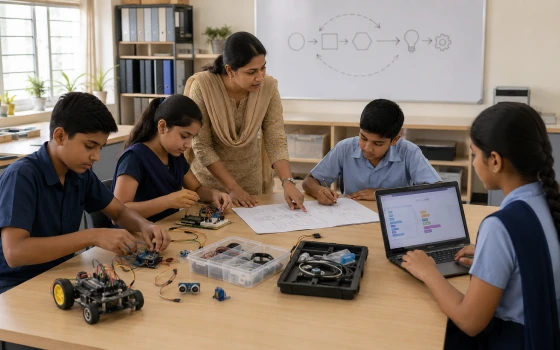
The starting position was familiar. A single equipment room, purchased in one order from a kit vendor. No curriculum integration. No teacher lesson plans. No assessment. Access by after-school club only, which meant self-selection, which meant boys.

Phase 2

Year 2 to 3: Choosing an Integrated STEAM Education Provider

The school shortlisted providers on five criteria: curriculum integration from Nursery to Class 12, teacher training beyond a vendor demo, board alignment, safety compliance, and a multi-year partnership model.

Phase 3

Year 3 to 5: The Integrated STEAM Ecosystem with AI Literacy

By Year 4, the school no longer had a Makerspace. It had a STEAM ecosystem. NatureNurture had co-designed four stage-appropriate spaces with the school's teachers.

The room had cost the school over Rs 12 lakh in capital. It generated one annual open-house photograph and no student outcomes. When the trustees asked for a return-on-investment review, the principal could produce activity counts but not learning evidence. This is the state most Indian K-12 STEAM programmes are still in.

Girls' participation rose from under 20 per cent to over 40 per cent in one academic year. The Makerspace stopped being an after-school club. It became a scheduled part of the timetable across five stages.

By Year 5, the school's teachers were co-designing STEAM projects without vendor dependency. Girls' participation reached parity with boys. The school was invited to demonstrate its STEAM programme at district and board-level events. And admissions inquiries from parents cited STEAM as a reason for choosing the school.

Stage-appropriate spaces

Four Spaces That Replaced One Underused Room

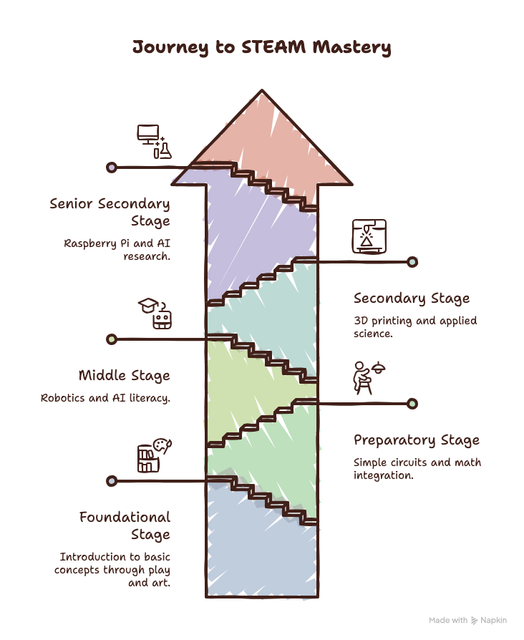
Foundational Stage STEAM Corner

For Nursery to Class 2, with blocks, storytelling props, art materials, and Jadui Pitara-aligned learning materials.

Preparatory Stage STEAM Lab

For Classes 3 to 5, with mathematics manipulatives, circuit kits, art-integration stations, and Computational Thinking worksheets and puzzles.

Middle Stage Makerspace

For Classes 6 to 8, with Arduino, micro:bit, robotics kits, sensor and IoT modules, and an AI Literacy zone using free and open-source no-code tools.

Senior Secondary Innovation Studio

For Classes 9 to 12, with 3D printing, Raspberry Pi, prototyping tools, applied research kits, and AI and machine learning kits.

AI Literacy pathway

The CBSE structure delivers 50 hours annually in Preparatory and 100 hours annually in Middle Stage, using free and open-source, platform-agnostic tools.

Evidence and outcomes

Continuous, formative, competency-based assessment through project presentations, journals, and rubrics rather than a written board exam.

What changed

What Changed Between Phase 1 and Phase 3

The equipment was largely the same. What changed was everything around it.

DimensionPhase 1 (Makerspace)Phase 3 (Integrated STEAM Ecosystem)
CoverageClasses 8 to 10 onlyNursery to Class 12
TimetableAfter-school clubScheduled in every stage
Teacher roleAbsentCo-designer of every project
AssessmentNonePortfolio and Holistic Progress Card
Girls' participationUnder 20 per centParity with boys
Policy alignmentMarketing claimNEP 2020, NCF-FS, NCF-SE, CT and AI 2026-27
Vendor relationshipOne-off kit saleMulti-year STEAM partnership
Trustee viewROI questionedNext-phase investment approved

The lesson for other school leaders is not about which robotics kit to buy. It is that STEAM is a curriculum discipline, not a room. A kit purchased without an integrated curriculum, trained teachers, stage progression, and assessment is a photograph, not a programme.

Provider selection

How Schools Should Choose a STEAM Education Provider

The provider question separates schools that will meet the 2026-27 mandates from schools that will scramble in the last quarter of 2027. NatureNurture recommends nine tests.

1

Curriculum integration from Nursery to Class 12, not just Middle and Senior.

2

Genuine Arts integration, taught and assessed, not decorative.

3

Teacher training as continuous professional development, mapped to NPST and the CBSE 50-hour CPD mandate.

4

Board alignment across CBSE, ICSE, Cambridge, and IB.

5

Policy alignment with NEP 2020, NCF-FS 2022, NCF-SE 2023, and the CBSE 2026-27 CT and AI curriculum.

6

Assessment integration with the Holistic Progress Card and SQAAF.

7

Safety compliance under BIS and ISI for under-14 use across every STEAM kit for schools.

8

A girls' and inclusion focus designed into the pedagogy, not appended to marketing.

9

A multi-year partnership model with content refresh, coaching, and outcome measurement.

STEAM kits for schools

STEAM Kits for Schools: Stage-Wise Mapping

Kits alone are not STEAM. But the right kits, matched to stage and outcome, are the physical scaffolding STEAM sits on.

StageCore STEAM kitsSupport tools
Foundational (Nursery to Class 2)Blocks, storytelling props, art materials, sensory bins, Jadui Pitara-aligned kitsPortfolio templates, observation checklists
Preparatory (Classes 3 to 5)Simple circuits, math manipulatives, art-integration kits, CT worksheets and puzzlesDIKSHA content, safety gear
Middle (Classes 6 to 8)Robotics, Arduino, micro:bit, sensor and IoT kits, AI Literacy kitsNo-code AI platforms, Scratch, MIT App Inventor
Secondary (Classes 9 to 10)3D printing, applied science kits, Makerspace tools, competition kitsRubrics, project management tools
Senior Secondary (Classes 11 to 12)Raspberry Pi, AI and machine learning kits, prototyping tools, research kitsData analysis platforms, LMS, portfolio review tools
NatureNurture approach

How NatureNurture Delivers This as a STEAM Education Provider

NatureNurture has spent over two decades designing K-12 curricula that treat STEAM as an integrated learning architecture, not a room. The NatureNurture Steam Education Provider model maps every kit, activity, and assessment to an NCF-FS or NCF-SE competency, to the Holistic Progress Card, and, for the 2026-27 cohort, to the CBSE Computational Thinking and AI curriculum framework.

Every stage has its own space, its own kits, its own teacher training track, and its own portfolio evidence.

Where kit-only vendors sell hardware and step back, NatureNurture co-designs the curriculum with the school's teachers, calibrates it to the school's board and context, and stays through implementation for the multi-year rollout. The Arts sit inside the curriculum, not on the fringes of it, and girls' participation is designed into the programme from the Foundational Stage upward.

secondary
DimensionNatureNurture (integrated STEAM Education Provider)Generic market alternative (kit-only vendor)
Core offerSTEAM curriculum integrated into CBSE and ICSE syllabusKits and hardware bundles
Stage coverageFoundational to Senior Secondary progressionTypically Middle and Senior only
The ArtsGenuinely integrated and assessedUsually absent, effectively STEM
Teacher capabilitySustained training and co-designOne-off vendor demo
AssessmentPortfolios and Holistic Progress CardNone
AI Literacy 2026-27Aligned to CT and AI curriculumAdd-on robotics only
Policy alignmentNEP 2020, NCF-FS, NCF-SE, ATLMarketing claims
Commercial modelMulti-year partnershipTransactional sale
InclusionDesigned for girls' paritySelf-selecting, boy-dominated

Hundreds of partner schools across India and the Middle East have moved through a version of this arc. The schools still buying kits as line items are the ones with the shortest window to catch up before the 2026-27 CT and AI curriculum lands in Preparatory and Middle stage classrooms.

Before the 2026-27 curriculum deadlines

To begin your school's STEAM transformation journey before the 2026-27 curriculum deadlines, speak with the NatureNurture team.

NatureNurture partners with schools across India and the Middle East to build NEP 2020, NCF-FS 2022, NCF-SE 2023, and 2026-27 CT and AI aligned STEAM ecosystems.

Frequently Asked Questions

Frequently Asked Questions

What is STEAM education, and how is it different from STEM?

STEAM adds the Arts to Science, Technology, Engineering, and Mathematics. STEM builds technical and analytical skills. STEAM adds creativity, design, communication, and cultural expression, and is transdisciplinary, taught and assessed across subjects rather than as isolated silos.

What is a STEAM Education Provider, and how should a school choose one?

A STEAM Education Provider is a K-12 curriculum partner that designs, delivers, and assesses STEAM as an integrated ecosystem. Choose on curriculum integration, teacher training, stage progression, board and policy alignment, AI Literacy readiness, safety compliance, and a multi-year partnership model, which is exactly how NatureNurture is structured.

What STEAM kits for schools should Indian K-12 schools invest in?

Stage-appropriate kits: Foundational blocks and storytelling props, Preparatory circuits and math manipulatives, Middle Stage robotics and AI Literacy kits, and Senior Secondary prototyping and AI and machine learning kits. All must be BIS and ISI safety-compliant for under-14 use.

How does STEAM align with NEP 2020?

NEP 2020 states there is "no hard separation between arts and sciences" and mandates experiential, arts-integrated learning across every subject and stage. STEAM is the pedagogy the policy assumes schools will run.

How does STEAM prepare students for the CBSE 2026-27 Computational Thinking and AI curriculum?

STEAM builds the Computational Thinking foundation, project-based habits, and portfolio evidence that the CT and AI curriculum requires, delivered across 50 hours per year in Preparatory and 100 hours per year in Middle Stage. NatureNurture's AI Literacy pathway is designed to that exact structure.

Do CBSE and ICSE schools need different STEAM approaches?

The STEAM pedagogy is common. Syllabus mapping, assessment integration, and lesson pacing must be board-specific, which is why an integrated STEAM Education Provider like NatureNurture builds multi-board portable curriculum from the start.

Written by the NatureNurture Team, a K-12 curriculum design and school transformation organisation partnering with schools across India and the Middle East to build NEP 2020, NCF-FS 2022, NCF-SE 2023, and 2026-27 CT and AI aligned STEAM ecosystems.

©2026 NatureNurture