Curriculum-integrated
Kits and tools designed as part of the curriculum itself.
Somewhere between the annual budget meeting and the parent-teacher orientation, the conversation about Educational Kits For Students turns into a shopping list. Which robotics box, which activity subscription, which lab supplier. At NatureNurture, working with hundreds of partner schools across India and the Middle East, that framing is the first sign a school is behind.
The rules changed years ago. NEP 2020 made experiential learning the default pedagogy across every stage and every subject. NCF-FS 2022 built the Panchaadi around materials. NCF-SE 2023 extended that logic through Class 10. The CBSE Computational Thinking and AI curriculum arrives in session 2026-27 with 50 to 100 hours of activity-based delivery per year. Yet most Indian K-12 schools are still procuring kits under assumptions that no longer hold.
Educational Kits for students in India in 2026 are policy-mandated, curriculum-integrated, stage-progressive learning materials aligned to NEP 2020, NCF-FS 2022, and NCF-SE 2023. NatureNurture designs these kits and educational tools for students as part of the K-12 curriculum itself, not as an add-on, spanning Foundational through Senior Secondary stages across CBSE, ICSE, Cambridge, and IB schools, and meeting BIS safety standards for all under-14 materials.
Kits and tools designed as part of the curriculum itself.
Materials mapped to learning steps, competencies, and outcomes.
Every kit tied to Holistic Progress Card and SQAAF evidence.
Built for CBSE, ICSE, Cambridge, and IB school ecosystems.
NEP 2020, Section 4.6, is unambiguous. Experiential learning "will be adopted, including hands-on learning, arts-integrated and sports-integrated education, and story-telling-based pedagogy, among others, as standard pedagogy within each subject." The verb is "will", the subject is every subject, the stages are all four. NCF-FS 2022 organises early years pedagogy around the Panchaadi, five learning steps in which children gather information by asking questions, exploring, and experimenting with ideas and material. Material is structurally central, not decorative.
Around this policy scaffold, three parallel timelines are collapsing on Indian schools. The Atal Innovation Mission has established 10,000 Atal Tinkering Labs engaging over 1.1 crore students, with 50,000 more planned by 2030 under ATL 2.0. CBSE has mandated Composite Skill Labs in every affiliated school within three years of Circular Skill-75/2024. And the CBSE Computational Thinking and AI curriculum lands for Classes 3 to 8 in session 2026-27, demanding hands-on, activity-based delivery for 50 to 100 hours per year per class. NatureNurture designs against this entire timeline, not against a shopping list.

The eight myths below are the ones that most consistently derail educational kits strategy in Indian K-12 schools. Each is followed by the evidence that busts it and the concrete alternative NatureNurture recommends.
NEP 2020 Section 4.6 applies to all stages, in every subject. NCF-SE 2023 explicitly requires experiential learning across Sciences, Mathematics, Arts, Social Sciences, and Humanities at the Middle Stage. ATL covers Grades 6 to 12. CBSE Composite Skill Labs cover Classes 6 to 12. The CT and AI curriculum runs through Class 8, with Classes 9 and 10 to follow. Kits scale up, not down. What to do instead: build a stage-progressive kit strategy from Foundational manipulatives to Senior Secondary Makerspace, which is exactly how NatureNurture architects for its partner schools.
NCF-FS 2022 embeds material at every one of the Panchaadi's five learning steps. Samagra Shiksha and NIPUN Bharat fund TLMs at up to Rs 500 per child per annum, a recurring allocation. The CBSE 2026-27 curriculum requires 50 to 100 hours of activity-based delivery every year. ATL grants include Rs 2 lakh per year for five years for operations, not just setup. What to do instead: run kits as an annually replenished, curriculum-mapped system tied to units and learning outcomes.
NCERT Director Prof Dinesh Prasad Saklani has stated that Jadui Pitara "serves as a model standard and not the absolute" and can be modified according to local resources and context. The American India Foundation documents that pebbles, bottle caps, and beads can function as legitimate TLMs. Carbonneau, Marley, and Selig's 2013 meta-analysis of 55 studies (N=7,237) found that the learning effect of manipulatives is moderated by instructional and methodological characteristics, meaning teacher guidance and design decide the payoff, not price. What to do instead: procure fit-for-purpose, context-appropriate kits designed alongside teacher training, which is the model NatureNurture co-builds with schools.
Carbonneau et al. 2013 found significant small-to-moderate effects favouring manipulatives, with moderate-to-large effects on retention. Stohr-Hunt 1996 linked frequent hands-on science to higher achievement. Pratham and J-PAL's Teaching at the Right Level RCTs in India produced learning gains of 0.14 to 0.70 standard deviations across states. Against a backdrop where only 44.8 per cent of Class 5 rural children read at Class 2 level per ASER 2024, materials-rich teaching is a lever, not a luxury. What to do instead: tie every kit to a measurable learning outcome on the Holistic Progress Card.
This is the myth that ruins Makerspaces. Carbonneau et al. found that learning gains are moderated by instructional and methodological characteristics, meaning the teacher and the design decide the payoff. Tamil Nadu's Activity-Based Learning programme, scaled to more than 37,000 government schools, showed mixed outcomes precisely because implementation varied. CBSE mandates teacher handbooks and NISHTHA training via DIKSHA for exactly this reason. What to do instead: procure kits, teacher training, and lesson plans as one integrated package, which is how NatureNurture delivers to its partner schools.
An Atal Tinkering Lab requires a trained science teacher, roughly 1,000 square feet of space, and Rs 2 lakh per year in operations and maintenance. It draws on the AIM network of over 6,200 Mentors of Change. The PM SHRI School Quality Assessment Framework rates functionality and usage, not mere presence of equipment. A Makerspace without teacher capacity, protected timetable time, and student projects is inventory, not learning. What to do instead: budget as much for implementation support, mentoring, and usage assessment as for hardware.
Jadui Pitara covers only ages 3 to 8 and is designated by NCERT as a model standard and not the absolute. The needs of ATL (Grades 6 to 12), Composite Skill Labs (Classes 6 to 12), and the CT and AI curriculum (Classes 3 to 8) are separate and target older learners. Jadui Pitara is a floor, not a ceiling. What to do instead: layer contextual, stage-appropriate kits and tools on top of Jadui Pitara across every stage.
The Toys (Quality Control) Order 2020, in force since 1 January 2021, makes the ISI mark legally mandatory for all toys and educational materials for children under 14 in India. Seven Indian Standards apply, covering mechanical safety, flammability, toxicity limits for cadmium, mercury, and phthalates, and electrical safety. BIS has reported that around 17 per cent of tested samples fail certification. Uncertified and grey-import kits are illegal, seizable, and a real liability exposure for the school and its trustees. What to do instead: procure only ISI-marked, age-graded, non-toxic, BIS-certified kits, which is standard practice in NatureNurture's supply pipeline.
The two terms are used interchangeably in most school procurement conversations, and the confusion costs money. A kit is a bundled set of materials designed for a specific learning goal, such as a fractions kit, a robotics starter kit, or Jadui Pitara. A tool is an individual instrument used across many learning goals, such as a 3D printer, a rubric template, or DIKSHA content.
Educational Tools For Students span three families: digital tools (DIKSHA, PM eVIDYA, adaptive learning apps, no-code AI platforms, learning management systems), physical tools (workbenches, screwdrivers, safety gear, measuring instruments), and pedagogical tools (rubrics, portfolio templates, Holistic Progress Card templates, observation checklists). NatureNurture builds the curriculum around kits and tools together, not either category in isolation.
DIKSHA, PM eVIDYA, adaptive learning apps, no-code AI platforms, learning management systems.
Workbenches, screwdrivers, safety gear, measuring instruments.
Rubrics, portfolio templates, Holistic Progress Card templates, observation checklists.
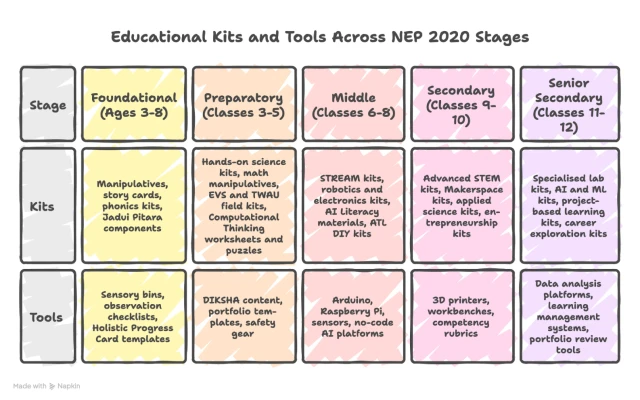
| NEP Stage | Kits (bundled) | Tools (individual instruments) |
|---|---|---|
| Foundational (Ages 3-8, Nursery to Class 2) | Manipulatives, story cards, phonics kits, Jadui Pitara components | Sensory bins, observation checklists, HPC templates |
| Preparatory (Classes 3-5) | Hands-on science kits, math manipulatives, EVS and TWAU field kits, CT worksheets and puzzles | DIKSHA content, portfolio templates, safety gear |
| Middle (Classes 6-8) | STREAM kits, robotics and electronics kits, AI Literacy materials, ATL DIY kits | Arduino, Raspberry Pi, sensors, no-code AI platforms |
| Secondary (Classes 9-10) | Advanced STEM kits, Makerspace kits, applied science kits, entrepreneurship kits | 3D printers, workbenches, competency rubrics |
| Senior Secondary (Classes 11-12) | Specialised lab kits, AI and ML kits, project-based learning kits, career kits | Data-analysis platforms, LMS, portfolio-review tools |
NatureNurture has spent over two decades designing K-12 curricula that treat educational kits and tools as an integral part of the curriculum itself, not a separate procurement exercise. The NatureNurture model maps every kit and tool to an NCF-FS or NCF-SE competency, a Holistic Progress Card outcome, and a stage in the Panchaadi. That means each kit has a lesson plan, an assessment, and a place in the teacher's weekly timetable before it enters the classroom.
Where generic vendors sell either robotics hardware or activity boxes, NatureNurture builds an integrated ecosystem across CBSE, ICSE, Cambridge, and IB, spanning all four NEP stages. The kits are BIS and ISI safety-certified for under-14 use, age-graded, and paired with structured teacher training and NISHTHA-aligned CPD. For 2026-27, NatureNurture's Foundational and Preparatory materials already reflect the CBSE Computational Thinking and AI curriculum, and its Middle and Secondary architectures are ready for the ATL 2.0 and Composite Skill Lab requirements.

| Dimension | NatureNurture approach | Generic market alternative |
|---|---|---|
| Relationship to curriculum | Kits and tools designed as part of the curriculum | One-off purchase, disconnected from curriculum |
| Teacher enablement | Teacher training and lesson plans included | Limited or no teacher training |
| Stage coverage | Stage-progressive across all four NEP stages | Single age band, one-size-fits-all |
| Policy alignment | NEP 2020, NCF-FS, NCF-SE, CBSE CT-AI aligned | Marketing-led, variable |
| Safety | BIS and ISI certified, age-graded | Safety varies, grey imports common |
| Outcomes | Tied to Holistic Progress Card and SQAAF | Not outcome-mapped |
| Boards and geography | Multi-board, India and Middle East | Often single-board or product-only |
Hundreds of partner schools across India and the Middle East have already moved to the NatureNurture model. The schools still buying kits as line items are the ones falling behind on the pedagogy their boards are already enforcing.
NatureNurture partners with schools across India and the Middle East to build NEP 2020, NCF-FS 2022, and NCF-SE 2023 aligned learning ecosystems.
Educational kits for students are bundled sets of learning materials designed for a specific learning outcome, such as manipulatives for early numeracy or robotics kits for Middle Stage STREAM. Schools need them because NEP 2020 Section 4.6 makes experiential and hands-on learning the standard pedagogy across every stage and subject.
A kit is a bundled set of materials tied to a specific learning goal. A tool is an individual instrument, physical, digital, or pedagogical, used across many learning goals. A robotics kit is a kit. A 3D printer, a rubric template, or DIKSHA content is a tool.
NEP 2020 Section 4.6 mandates experiential and hands-on learning as standard pedagogy in all stages and every subject. It does not prescribe a specific kit brand, but its pedagogical requirements cannot be met without materials, TLMs, and manipulatives.
Both boards must deliver against NCF-SE 2023 competencies, so the pedagogical requirement is the same. Delivery differs at the margins, and a well-designed multi-board curriculum, of the kind NatureNurture builds, uses the same core kit architecture for both.
Jadui Pitara is designated by NCERT as a model standard and not the absolute, covers only ages 3 to 8, and does not address ATL, Composite Skill Labs, or CT and AI curriculum needs. Schools need additional stage-appropriate kits and tools across every stage.
The BIS Toys (Quality Control) Order 2020 makes the ISI mark legally mandatory for all toys and materials for children under 14. Seven Indian Standards cover mechanical safety, flammability, toxicity limits for cadmium, mercury, and phthalates, and electrical safety. Around 17 per cent of tested samples fail BIS requirements, so uncertified procurement carries real liability.
©2026 NatureNurture